
For Four Years I Watched My Cognitive Sharpness Decline and Called It Aging. My Physician Called It Something More Specific — and More Addressable — Than That.
I'm 58 years old. I spent 30 years as a high school history teacher — a career that runs entirely on the ability to recall names, dates, contexts, and narrative threads across hundreds of students and thousands of historical events simultaneously. When the first signs of cognitive slippage began in my early fifties, I managed them the way most people manage them: I made more notes, relied more heavily on written reminders, and quietly accepted that the mental sharpness that had defined my professional identity was declining with age.
My father had gone through the same progression — gradually, then suddenly, then completely. By the time I noticed the pattern in myself, I had already accepted a version of the same trajectory as my future. That acceptance felt like wisdom. What it actually was, as my physician would eventually explain, was premature surrender.
The conversation happened during a routine check-up I almost cancelled. My physician asked about cognitive changes. I described the pattern — the names that slipped, the thoughts that didn't complete themselves, the conversations I had to work harder to follow than I used to. He said something I hadn't expected: that the cognitive decline I was experiencing wasn't primarily a neurodegenerative process. It was a vascular one. The brain is the most metabolically demanding organ in the body — consuming 20% of total oxygen despite representing only 2% of body weight. When cerebral circulation becomes less efficient with age, every cognitive function it supports degrades simultaneously. And cerebral circulation is primarily regulated by one molecule: nitric oxide.
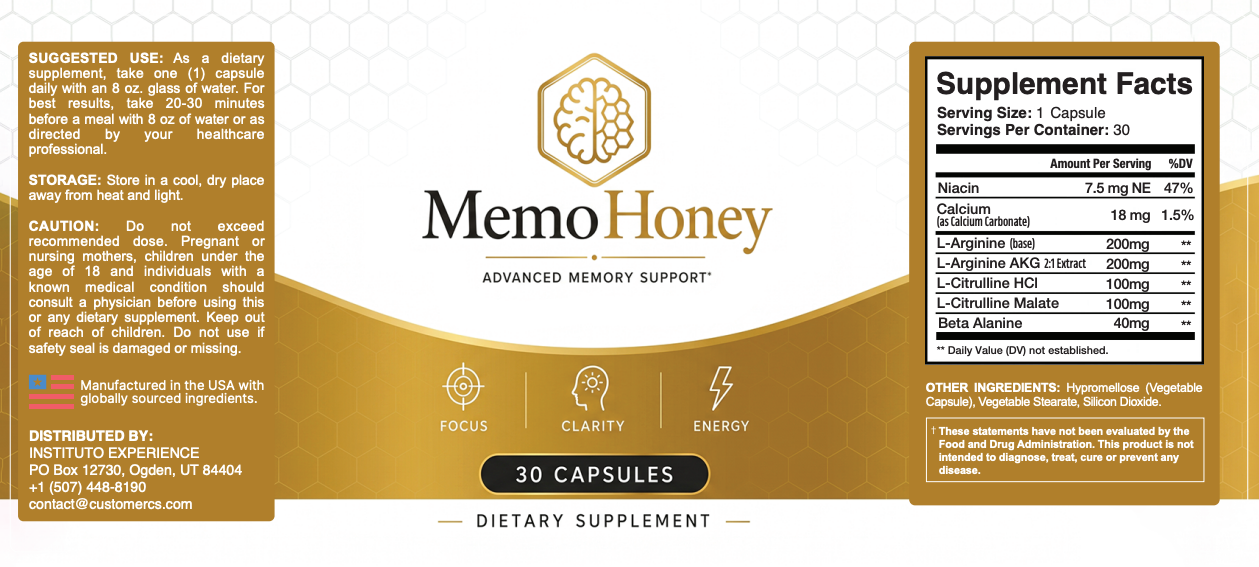
He explained that nitric oxide — produced by the cells lining the brain's blood vessels — is the primary signal for arterial wall relaxation and dilation. When nitric oxide production declines, cerebral blood flow becomes progressively less efficient, neurons receive less oxygen and nutrient delivery, and the downstream cognitive effects — the forgetting, the brain fog, the mental effort that used to be effortless — accumulate. He mentioned L-Arginine and L-Citrulline as the most documented amino acid precursors for supporting nitric oxide production, Niacin for the NAD+ energy pathway that keeps neurons functioning, and Beta-Alanine for the antioxidant carnosine that protects neurons from the oxidative stress that accelerates cognitive decline. When I found MemoHoney — combining all six of these compounds in a single daily capsule — I bought the 6-bottle kit and gave it a genuine 180-day protocol. What followed was the first sustained reversal of the cognitive decline I had been accepting as inevitable for four years.